

How To Read User Engagement Customer Service
In today'southward depression-attending economy, site engagement tin can be considered an indicator of your website's success.
Content date metrics are important because they prove how your content strategy aligns with user interest.
Furthermore, customer date is related with overall profitability, as engaged users are more than likely to buy, become repeat customers, and share the production/service with other people.
Earlier y'all decide on the specific user engagement metrics you want to track, you have to decide which ones brand the most sense for your business organization.
Hither are some of the most common (and almost important) user engagement metrics.
1. Pageviews
What are Pageviews?
Pageviews, sessions, and users are the near common metrics used to bespeak traffic on your website. Pageviews are the most basic of all user engagement metrics, measuring an instance of a user visiting a particular page on your website.
Measuring pageviews can aid you lot to empathise how often people visit your website. A college number can be assumed to be an indicator of interest and/or skillful SEO practices, since search engines are ofttimes the biggest drivers of traffic to websites.
Conversely, pageviews tin also indicate that people are poking around your website because they can't find anything.
Pageviews show traffic but without tying in the context of other related metrics, they can't assistance you lot to fully sympathize the meaning behind these numbers.
How to Track Pageviews
You lot can employ Google Analytics to track most user engagement metrics. Information technology is mayhap the most comprehensive free analytics software tool available.
Yous can find pageview metrics nether Audition > Overview, and selecting a relevant fourth dimension period.
Aside from pageviews showing how many people visited your website over a given period of time, pageview assay tin besides be used to evidence whether website changes (i.eastward., a new layout, an online ad entrada, etc) are performing as expected.
Every bit a simple rule of thumb, when your pageviews increment, information technology means that the changes yous implemented must exist working — at least in terms of driving traffic.
How to Optimize/Amend Pageviews
An increase in pageviews can be an indicator of good SEO practices.
Some things you can do to increment pageviews:
- Provide a good user experience: Ensure your website loads fast. Users tend to abandon websites that do not load in 2-three seconds. To improve site load speed, consider the implications of your design on usability, categorize content so it is easily found, and make sure that your website/content is mobile-optimized — since more than half of the world accesses the net from their mobile phones.
- Give your visitors interesting content to click on: Create viral content, merely back it upwardly by making information technology worth people's time (not clickbait). Use SEO best practices, similar keyword research and internal linking of related content, to make sure that content is plant and read. Suspension long posts into series and feature popular posts prominently.
- Promote your website: Get the word out on social media, guest blogging, and related forums.
2. Time on Page
With then many websites churning out content on a regular footing, gaining an understanding of how much time people actually spend on your content has become an important user date metric.
In that location are 2 means to await at time spent:
- Micro view: time spent on page
- Macro view: the boilerplate session duration or average fourth dimension spent on site
What is Time Spent on Page?
It's fairly straightforward: the time spent on page user engagement metric measures the time a user spends on a page on your website.
This metric provides an indication of interest.
For case, the average person reads at a rate of about 200-250 words per infinitesimal. If you have manufactures that are 2,100 words long (the optimal weblog mail service length, equally plant by Medium) and a visitor just spent x seconds on that page, you lot can be certain that they weren't very interested in the content.
What is Boilerplate Session Elapsing?
Average Session Duration (formerly known every bit Boilerplate Time Spent on Site) measures the length of an average session (Session Elapsing), over a specific fourth dimension menses, divided past the total number of sessions over a specific time period.
Session refers to a group of user interactions with your website. The average session duration refers to the total time spent on your website. This is different from time spent on page because information technology tracks all the activity a visitor has completed on your website versus tracking just the time spent on a certain folio.
How to Track Fourth dimension Spent
You can use Google Analytics to rails how much time people spend on your website. You tin find both average session duration metrics nether the 'Acquisition' tab.
Google Analytics tracks page activities using timestamps every time a page loads or when an action triggers more events. This is measured by looking at the divergence between when the first outcome occurred compared to the adjacent.
For example: if a page was viewed at 9:23 am and the next 1 was viewed at 9:26 am, the time spent on page for the kickoff folio is 3 minutes.
The problem with using timestamps to runway activity is that it cannot track the fourth dimension spent on the exit page. The leave page is the last page the visitor sees earlier they get out the website completely.
This means that if a visitor spends 5 minutes on your website but does non visit another page, Google Analytics has no way of knowing or recording this.
So if someone only visited 1 folio and exited it, Google Analytics records the session duration every bit 0 — regardless of how much time they actually spent on your website.
Thus, the values of average session duration and time spent on folio reported are normally lower than what they really are and should not exist taken at face value.
Instead, wait at the distribution of session duration data to take a amend idea of the typical session — and remove outliers.
What Counts Toward Fourth dimension Spent?
Many people wonder about what exactly counts toward the time spent on site user engagement metric. Website parking occurs when you open up a tab and leave information technology open up to read later on.
The reply is that it depends on how the Google Analytics lawmaking is triggered and how fast information technology is sent to Google Analytics.
Additionally, Google answers, "Past default, a session lasts until in that location'south 30 minutes of inactivity, but you lot can adjust this limit and then a session lasts from a few seconds to several hours".
A similar question you may have: does watching video count toward time on site? The answer? Aye! Google Analytics tracks interaction events, or events where a user interacted with the website.
How to Optimize/Improve Time Spent on Page
Because every website is different (in terms of industry, size, optimization), y'all should focus on comparing your electric current website statistics to your own past data.
Cull a specific time frame (a year is recommended) and apply Google Analytics advanced filtering options to determine which pages receive the well-nigh traffic, consistently.
Make your way to Behavior > Content Drilldown.
On the Primary Dimension field, cull Page. So, make your style to the Advanced filtering choice. Cull to filter by Unique Pageviews, then choose a number to match upwardly against.
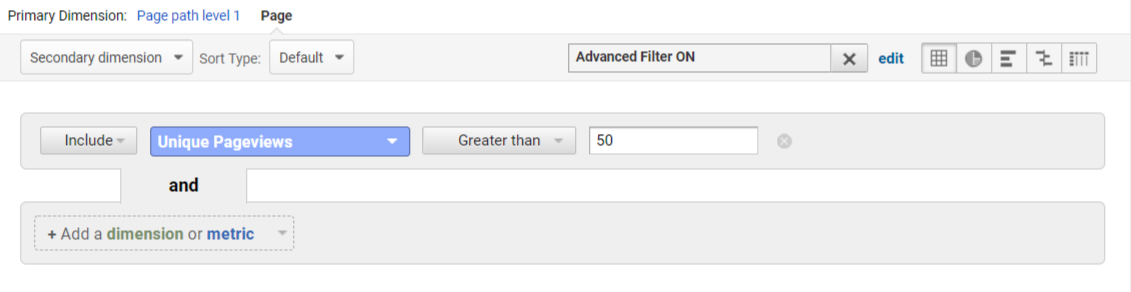
You'll encounter the average time spent on page change.
If yous know that your average web log post is about 500 words, and your readers spend between 1-ii minutes reading them, then yous're in a good range.
But if they spend less time on the page, and then analyze what could be making them exit prematurely: Is it your writing style? Does your folio take a long time to load?
How to Optimize/Improve Average Session Duration
Session durations are a little harder to optimize. Because information technology measures more of a macro view, in that location are different considerations than that of time spent on page.
For ane, y'all need to consider the overall user experience on your site. This includes:
- The variety and value of content on your site.
- Ease of navigation on your site and user site experience.
- Clear calls-to-activity (CTAs).
If yous're able to optimize these three things, you lot may run into average session duration rise.
3. Bounce Rate
Closely related to time spent is the bounce rate. A common trend observed is that the bounce rate is inversely proportional to the boilerplate session duration: as the bounce rate increases, the average session duration decreases.
What Is Bounce Charge per unit?
The bounciness rate is the pct of visitors to a website that exit afterwards simply viewing one page. The bounce charge per unit gives an indication of how practiced your content is, considering if people are leaving without taking action, then your content isn't doing its chore.
People may bounce for several reasons:
- Your CTA/offer isn't clear.
- Your content/offer isn't what they expected.
- They got bored.
- You're non offering something different.
While it is important to measure how engaged your visitors are, information technology'south also important to measure out how unengaged your visitors are.
You might have loftier traffic numbers simply if you lot also have loftier bounce rates, this ways your content isn't engaging enough to make website visitors stick around.
How to Track Bounce Rate
In Google Analytics, become to Behavior > Site Content > All Pages. You will encounter a column for Bounce Rate.
Think that using Google Analytics tin be slightly problematic because yous demand a trigger result so that Google Analytics won't count an early go out towards your bounce rate.
Bated from Google Analytics, yous can employ the SimilarWeb tool to track bounce rates and even size yours up confronting your competitors.
How to Improve Bounce Rate
Await at your pages with high engagement and low bounce rates. Try to make up one's mind what you did right on the page that could be applied to other pages.
Similar to Boilerplate Session Duration, some specific means y'all tin lower bounce rates:
- Produce smashing content and apply internal linking to get people interested in clicking through to other related pages on your website.
- Evangelize on your content. Exist reliable, helpful, and memorable.
- Use articulate CTAs.
- Provide a great user experience: no pop-up ads, sound, or automatic video playback.
4. Tiptop Exit Pages
What is the Top Exit Page?
Go out pages are the last pages accessed before leaving a website. The get out rate measures the percentage of people that leave your website from the exit page.
The get out pages (and subsequently, the leave rates) are related to bounce rates in that they both consider the terminal pages a visitor goes to on a website.
The main divergence between these user appointment metrics?
The bounciness rate takes into consideration the number of visitors that exit your website later on visiting a single page.
Calculating the exit rate can be helpful, peculiarly when your website encourages customers to follow a certain path (the buyer's journeying). Knowing your top exit pages tin assistance you make sense of why your get out charge per unit is the way information technology is.
Some pages are designed to have high exit rates, like your contact page, or a "Thank you" page. When a folio is designated every bit an go out page, a high go out rate indicates that customers completed the desired action.
A high exit rate on a non-exit page tin be caused by:
- Poorly organized information on your website (hierarchical bug).
- Missing CTA (so the person simply exits the website).
- Overwhelming amount of data.
- Defective/Missing information.
How to Track Height Exit Pages
Exit pages can be determined past going to Behavior > Site Content > Go out Pages on Google Analytics.
There, you lot'll see the number of exits, the number of pageviews, and the exit rate (% Go out). To calculate the exit rate, divide the number of times a company exits a particular page by the total number of folio views.
It's worth noting that a high leave rate is correlated to time on page values that vary a lot, and can, in fact, contribute to bloated data.
How to Optimize/Improve Height Get out Pages
Advisedly plan your user menstruum/journeying so that you can plan for which pages should have loftier exit rates.
Since elevation leave pages and exit rates are related to bounce rates, to optimize them, yous have to:
- Amend your content.
- Improve site usability/information system.
- Have clear CTAs.
5. Pages per Session
What is Pages per Session?
Another way of measuring interest in your content is pages per session, or the number of unique page visits per session.
From a business organization perspective, the higher the pages per session metric, the better. This is considering a high pages per session count shows that your website visitors looked effectually and visited more than one page – truly engaging with your website.
Bounciness rates are similar to pages per session, but while bounciness rates look at the adjacent step (or page), pages per session looks at the whole path the visitor follows.
How to Track Pages per Session
Go to Conquering > All Traffic > Channels on Google Analytics. You'll encounter a cavalcade for Pages/Session.
To summate the number of pages per session, take the sum of the number of pages each user visited and divide it by the total number of sessions.
A high value of pages per session does not necessarily mean that people are interested in your content – that's why it is important to look at pages per session in conjunction with average session elapsing and bounce rate.
A folio with loftier pages per session – only low session elapsing and bounce rate – tin indicate page flipping behavior due to disinterest, irrelevant content, or difficulty in navigating your website.
How to Optimize/Ameliorate Pages per Session
Provide 'next steps', or content that aligns with company involvement. Marshal your content hierarchy/menses with the buyer's journey.
6. Page/Roll Depth
What is Page/Whorl Depth?
Page (or curl) depth measures how thoroughly your audience consumes your content by tracking where on the page they finish reading.
This can indicate two things:
- Readability: If your content is easy to read, people volition go farther downwardly the page.
- Interest: It is assumed that the farther people scroll down your page, the more they want to consume your content.
How to Runway Page/Scroll Depth
Google Analytics does not take a built-in option to measure curlicue depth, which is why you lot have to install the Scroll Depth Google Analytics plugin to enable tracking.
The plugin tracks the percentage of your page where visitors finish: 25%, fifty%, 75%, or 100% depth, as well as which elements they coil to, and pixel depth.
Pixel depth provides an absolute mensurate of where the audience stops, comparison this across devices where screen heights vary. The plugin sends the data to Google Analytics via Events.
Some other pick is to use Google Tag Manager. Just like the Scroll Depth plugin, information technology allows you to track pixel and percentage depth.
How to Improve Folio/Gyre Depth
Consider the elements that correlate to the various scroll depths where people drib off:
- What'south happening?
- Is there something about the folio that'due south negatively impacting user experience?
- Is content starting to fall flat as visitors make their way deeper into an commodity?
Armed with the data and understanding you now have behind the most pop user engagement metrics, you'll accept multiple options to approach fixing this problem.
7. Unique Visitors
What Is a Unique Visitor?
Unique visitor is a term used to refer to a person that visits a website at least once during the reporting flow. Google puts more accent on tracking page views (or visits) but the unique visitors metric shows how many individuals your website actually reaches.
How to Rails Unique Visitors
Whenever you visit a website, Google Analytics assigns y'all a client ID that is stored in a cookie in your browser. This customer ID is unique to every browser and not IP accost, so if you visit a website using another browser, Google Analytics will recognize you equally some other unique user.
This tin pose a problem or written report inaccurate results considering of situations such as:
- Multiple people in a household sharing 1 figurer. There may be multiple visitors but only one is registered.
- A single user can visit your website from different computers or unlike browsers. This will be counted every bit multiple visits, when they actually came from one person.
- Someone manually clears their cookies and will be counted as two users in reporting.
In Google Analytics, go to Audience > Overview and look at the Users metric. This will tell you the number of unique visitors to your site.
Tracking and comparing your stats for unique visitors over a specific time menstruum can tell you whether any new visitors are discovering your website (useful when you lot launch new campaigns or ads), or if your traffic comes from returning users.
How to Optimize/Improve Unique Visitors
- Know your audition. If you have a expert grasp of who your existing audience is, you tin can use these metrics to accept steps to discover a new/related audience segment.
- Promote your website, taking intendance to look toward the touch on different audience segments.
8. New vs. Returning Visitors
What Are New vs. Returning Visitors?
New users are users who are accessing your website for the beginning fourth dimension on a specific device.
Every bit mentioned, Google uses customer IDs to track users. If you're using a mobile phone to access a website — then using your desktop to visit the same website again (but the start time on the desktop) — Google counts this activity as two new visitors.
To their credit, Google is condign smarter about this. When you lot're signed in on Google Chrome using two dissimilar devices, it volition merely record the showtime device as a new visitor and the second device as a returning visitor.
Returning visitors are those that have previously visited your website. Google defines new users within a two-year time frame. If you revisit a website within the ii-year time frame, yous are considered a returning visitor, and if you lot visit a website again after more than ii years, you will be counted as a new company once more.
This metric is presented every bit a pie graph, comparing the ratio between the two.
How to Track New Visitors vs Returning Visitors
Notice this data nether Audience > Behavior > New vs Returning.
You'll see a table comparing the behavior of new and returning visitors with some of the metrics previously discussed, such as bounce rate, pages/session, and boilerplate session elapsing.
Y'all tin check new users nether Acquisition > Overview. Under the Acquisition tab, you'll as well be able to see the Source/Medium of the traffic, also equally Referral Source.
If your returning visitors metric is higher than new users, this might be a sign that you accept a loyal ring of followers. The reverse situation demonstrates that you have some work to do to get people to come back again.
How to Optimize/Improve New vs. Returning Visitors
Your New vs Returning Visitors graph can reflect the results of campaigns yous used to promote your website.
A few examples:
- Brandish advertising aims to target new (relevant) users, so if the entrada was successful, expect an increase in new users (slightly larger than from social, depending on the advertising budget).
- Organic search tends to result in even distribution.
- Email marketing from your CRM should pb to more than returning visitors. If it's a new list of prospects, expect more new visitors.
- Directly traffic is counted when people type your website's URL in their browser or retrieve it from their bookmarked sites — this will testify more often than not returning users.
You lot tin segment your channels according to these traffic sources.
It's important to stack these dimensions against other metrics, similar goal completion.
If your returning visitors catechumen more than new visitors, recall of strategies to appeal to this group.
Or, if there's a higher bounce rate with returning visitors, there may be something incorrect with your content or user experience.
nine. Conversion Rate
Customer engagement is linked to overall profitability and can lead to conversions.
What is Conversion Charge per unit?
The conversion charge per unit is the percentage of website visitors that complete desired actions, such every bit:
- Purchasing any of your products or services.
- Downloading your app, ebook, etc.
- Contacting your business/submitting a class.
- Engaging with your website in some style.
A high conversion charge per unit tells you that your marketing tactics are effective because they resulted in your website visitors completing your end goal.
How to Track Conversion Rate
The bully thing well-nigh conversion rates is that y'all can tailor them to exist wide or specific in terms of things like:
- Overall conversion rate
- Marketing channel conversion rate
- Keyword conversion rate
Most social media platforms similar Facebook, Twitter, and Pinterest accept their own built-in analytics tools that can exist used to runway conversion rates. For websites, you can use tools such as Google Analytics or Google AdWords to track certain conversion rates.
There is a dedicated tab on Google Analytics for conversions, which allows yous to analyze data based on goals, attribution, or multi-channel funnels. There's besides an selection specific to ecommerce.
How to Optimize Conversion Rate
Because conversions are the cease goal, marketing is oft tasked with conversion rate optimization (CRO), which aims to maximize the number of conversions.
The basic principle of CRO?
To make everything seamless and like shooting fish in a barrel for the website visitors to convert.
What makes CRO unique is that aims to increase revenue with the traffic you lot're currently getting—so you lot tin can exercise CRO even if you don't have that much traffic to brainstorm with.
CRO starts with measuring analytics to know your baseline, analyzing this information and implementing changes (commonly called split or A/B testing). OptinMonster has several A/B testing tools and Google Optimize offers a costless alternative.
There are several means to increase conversion rates (here are 53 means you lot can do so), depending on what you lot're trying to optimize — every bit well as some uncommon CRO tactics to consider.
x. Abandonment Rate
What is Abandonment Rate?
Cart Abandonment Rate (as well referred to equally abandonment charge per unit) is the pct of carts abandoned to the number of initiated (or completed) transactions. This is specially pertinent for ecommerce businesses.
Based on the Baymard Establish'south enquiry compilation, near 69.23 percent of online shopping carts are abandoned, meaning that for every 10 transactions, merely 3 were successful.
If you're an ecommerce business owner, the goal is to go on abandonment rates low, and for customers to catechumen or purchase from their abased carts.
How to Rails Abandonment Charge per unit
Google Analytics now has a Conversions tab specifically for ecommerce.
Once you've set it up, go to Conversions > Ecommerce > Shopping Beliefs. At that place, you'll see information about the different stages of the customer journeying for the fourth dimension period you selected.
This includes customers that:
- Didn't add anything to the cart.
- Added something to the cart.
- Abased it.
- Those who abandoned at checkout.
Tracking cart abandonment at different stages allows to you lot monitor whatsoever unusual changes. For example, if one stage's abandonment rate is higher than usual, so this may be a sign of usability issues.
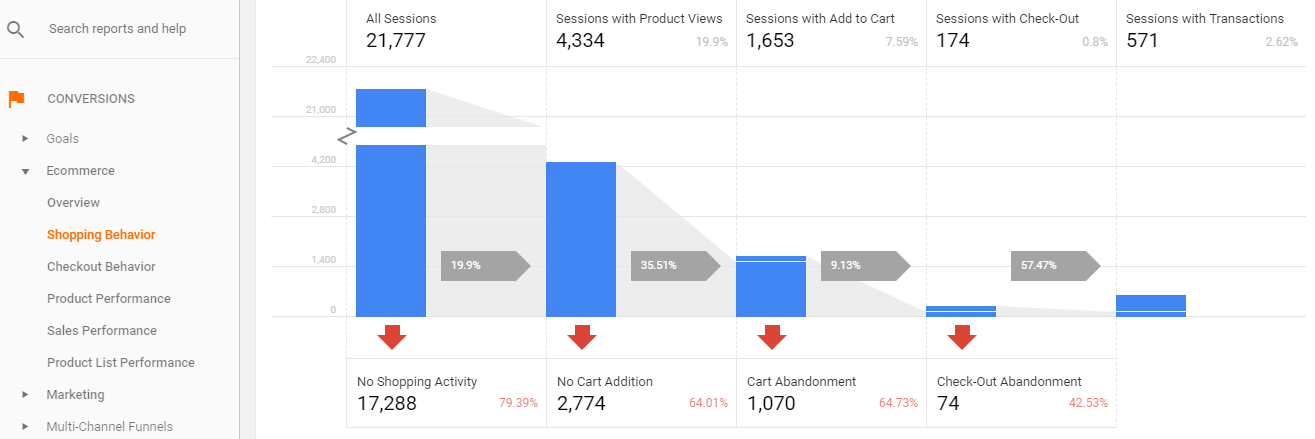
When yous click on the red pointer under each of these dimensions, Google volition prompt you to create a segment. This tin be applied to other reports and factors, such every bit device used, browser used, demographics, and traffic sources.
This is useful and then that yous can infer what influenced the cart to be abandoned. For case, if visitors are abandoning their carts at checkout, it could be that your checkout procedure is too long, payment options are too limited, or your shipping fee is too expensive.
How to Optimize/Improve Abandonment Rate
To improve abandonment rates, AcquireConvert suggests a BEFORE and AFTER strategy, specifically:
- Amend the ownership process BEFORE people cheque out AND
- Implement a follow-upwards strategy AFTER they abandon their carts
Before
Always ensure that your website is secure and functioning well, with clear CTAs.
Additionally, have a quick checkout process. Ecommerce behemothic Amazon earns so much considering of their quick checkout process that includes i-click ordering, dash buttons, and more than. Also, consider offering guest checkout and so that people don't accept to create an account to make a purchase.
Finally, avoid surprises—similar aircraft costs. Shipping cost is the number 1 reason for abandoned carts. Besides, to help avoid surprises, prove the customers progress indicators until checkout is consummate.
AFTER
Almost importantly, send abandoned cart emails. Depending on your e-mail marketing software, this is fairly like shooting fish in a barrel to set up.
Send at to the lowest degree three emails: the first one within an 60 minutes. If they are a first-time customer, you lot might want to ship them a discount code to encourage them to store. Create urgency with a time-sensitive offering.
Final Thoughts: User Engagement Metrics
User engagement metrics are important to rails because increased date is linked to increased profitability.
The adept news is that a free Google Analytics account can rails most of these metrics, and all of these metrics are interrelated. This means that optimizing for ane metric tin can help amend another.
For best results, focus on creating content that your target audience wants to read, with clear CTAs. From there, focus on optimizing your website and user site experience.
Prototype Credits
Featured Image: Paulo Bobita
Screenshots: Taken by author

How To Read User Engagement Customer Service,
Source: https://www.searchenginejournal.com/content-marketing-kpis/user-engagement-metrics/
Posted by: ramirezdecterral52.blogspot.com
0 Response to "How To Read User Engagement Customer Service"
Post a Comment