

How Much Forest Service Land Has Burned In Ca
"The federal government through the U.S. Wood Service (USFS), Bureau of Country Management (BLM) and National Park Service owns well-nigh xix meg acres of the total 33 million acres of forestlands in the state of California representing about 57% of the forest areas. Individual nonindustrial entities own about ane‑quarter (viii million acres) acres of forestland. These include families, individuals, conservation and natural resources organizations, and Native American tribes. Industrial owners—primarily timber companies—own 14 percent (4.5 meg acres) of forestland. State and local governments own most a three percent (1 million acres) combined. In total these not-federal entities represent virtually 43% of the states forest areas."
"While woods management responsibilities typically marshal with ownership, natural processes—such as wood fires, water runoff, and wildlife habitats—practice not observe those jurisdictional boundaries. Every bit such, federal and state agencies take developed certain arrangements to collaborate on direction activities across California's forests. For case, federal constabulary has a provision—known every bit the "Good Neighbor Dominance"—that allows states to fund and implement wood health projects on federally owned country
https://wattsupwiththat.com/2019/05/14/californias-government-solely-responsible-for-states-forest-management-and-wildfire-debacle/
California'southward regime solely responsible for states woods management and wildfire debacle
by Larry Hamlin
The inept government, political and regulatory policies of California have conspicuously driven the present forest direction calamitous weather condition with that failure leading to disastrous wildfires throughout the state.
Those government and political leaders that are responsible for this situation that has been decades in the making accept tried to conceal their incompetence by making scientifically unsupported propaganda claims that "climate change" caused this situation. These government driven bug are clearly identified in ii contempo reports – one past Cal Fire and the other past the California Legislative Analysts Role.
The state has established a huge gauntlet of regulatory agencies whose policies, procedures and actions take interfered with, misdirected, wasted and delayed the utilise of appropriate resources that have led to the nowadays forest direction and wildfire ending.
Cal Burn has identified a serial of loftier priority wildfire policy actions that need to be addressed and that reflect decades long policy inaction by the land which have led to the buildup of increasing wildfire risks that are responsible for the severity of recent California wildfires.

These actions are summarized in the report noted to a higher place and include the following assessments:
"Recognizing the demand for urgent action, Governor Gavin Newsom issued Executive Order N-05-xix on January nine, 2019. The Executive Order directs the California Section of Forestry and Fire Protection (CAL Burn), in consultation with other state agencies and departments, to recommend immediate, medium and long-term actions to help prevent destructive wildfires.
With an emphasis on taking necessary actions to protect vulnerable populations, and recognizing a backlog in fuels management work combined with finite resources, the Governor placed an emphasis on pursuing a strategic approach where necessary actions are focused on California'southward virtually vulnerable communities as a prescriptive and deliberative endeavor to realize the greatest returns on reducing hazard to life and property.
Using locally developed and vetted fire plans prepared past CAL FIRE Units as a starting point, CAL Burn identified priority fuel reduction projects that can be implemented most immediately to protect communities vulnerable to wildfire. It then considered socioeconomic characteristics of the communities that would be protected, including data on poverty levels, residents with disabilities, language barriers, residents over 65 or under v years of age, and households without a car.
In total, CAL FIRE identified 35 priority projects that tin be implemented immediately to help reduce public safety risk for over 200 communities. Project examples include removal of hazardous dead trees, vegetation clearing creation of fuel breaks and community defensible spaces, and creation of ingress and egress corridors. These projects can exist implemented immediately if recommendations in this report are taken to enable the work. Details on the projects and CAL Fire'southward analysis tin be found online which will remain updated in the coming months. The list of projects is attached to this written report as Appendix C.
CAL Burn has also worked with over forty entities including government and nongovernment stakeholders to identify administrative, regulatory and policy actions that can exist taken in the adjacent 12 months to begin systematically addressing community vulnerability and wildfire fuel buildup through rapid deployment of resources. Implementing several of these recommended deportment is necessary to execute the priority fuel reduction projects referenced above. Other recommendations are intended to put the state on a path toward long-term community protection, wildfire prevention, and woods wellness.
The recommendations in this report, while significant, are but part of the solution. Additional efforts around protecting lives and holding through dwelling house hardening and other measures must be vigorously pursued by government and stakeholders at all levels concurrently with the pursuit of the recommendations in this report. California must adopt an "all of the above" approach to protecting public prophylactic and maintaining the health of our forest ecosystems.
It is important to notation that California faces a massive excess of forest management work. Millions of acres are in demand of treatment, and this work— once completed—must exist repeated over the years. Too, while fuels treatment such equally wood thinning and creation of fire breaks can assistance reduce fire severity, wind-driven wildfire events that destroy lives and holding will very likely still occur.
This study'due south recommendations on priority fuel reduction projects and administrative, regulatory, and policy changes tin protect our most vulnerable communities in the short term and place California on a trajectory away from increasingly destructive fires and toward more than a moderate and manageable fire authorities."
Governor Newsom had to invoke the declaration of a State of Emergency in late March of this year to waive California's onerous and overbearing environmental laws and regulations to allow for these actions to embark in a timely fashion. These most recent deportment however represent only very small office of magnitude of the forest management and wildfire problems that must be dealt with by California that will take many years to address.
Another state report completed in 2018 that received lilliputian attention by the media documents in much more detail the huge extent of the problems confronting California's forest management responsibilities.
The California Legislative Annotator's Office (LAO) conducted a comprehensive review of the country's wildfire and woods direction situation and presented their results in a report titled "Improving California's Forest and Watershed Direction" which identifies the most critical problems facing the land in these areas including assessing the responsible agencies that need to take a multitude of boosted actions.

The study conspicuously identifies the multiple entities that accept ownership responsibleness for California's forestlands including country, federal, local agencies and private parties having numerous regulatory, environmental and administrative responsibilities and government relative to California'south wood and the manner in which these agencies share jointly in the responsibilities for addressing actions needed to improve the forest wellness and watershed management.
The patchwork of Federal, State, local authorities and private entities which own California's forest is displayed beneath in Effigy iii from the LAO written report.

The federal government through the U.Due south. Wood Service (USFS), Agency of Land Management (BLM) and National Park Service owns about nineteen million acres of the full 33 million acres of forestlands in the state of California representing about 57% of the woods areas. Private nonindustrial entities own about one‑quarter (8 one thousand thousand acres) acres of forestland. These include families, individuals, conservation and natural resource organizations, and Native American tribes. Industrial owners—primarily timber companies—own xiv percentage (four.5 one thousand thousand acres) of forestland. State and local governments ain about a iii percentage (ane meg acres) combined. In total these non-federal entities represent about 43% of the states woods areas.
Increased fire risks are present throughout the state driven past forest conditions that accept been allowed to develop for years. The report notes that:
"Dense forest stands that are proliferated with small-scale trees and shrubs contain masses of combustible fuel within close proximity, and therefore can facilitate the spread of wildfires. Moreover, these smaller trees can serve every bit "ladder fuels" that deport wildfire up into the crowns of taller trees that might have otherwise been out of reach, adding to a fire'southward potential spread and intensity. Equally shown in Figure 11, Cal Fire estimates that most forested regions of the state confront a high to extreme threat of wildfires. Cal Fire estimates the level of threat based on a combination of anticipated likelihood and severity of a fire occurring."

"In addition to increasing fire gamble, overcrowded forests and the associated competition for resources tin also make forests less resilient to withstanding other stressors. For example, trees in dense stands become more than vulnerable to disease—including infestations of pests such equally bark beetles—and less able to endure water shortages from drought conditions. This vulnerability has been on display in recent years, as an estimated 129 one thousand thousand trees in California'south forests died betwixt 2010 and 2017, including over 62 million dying in 2016 alone. While this is a relatively small share of the over iv billion trees in the country, historically, about 1 million of California's trees would die in a typical year. Moreover, most of the die‑off is occurring in concentrated areas. For example, the Sierra National Forest has lost most 32 million copse, representing an overall bloodshed rate of betwixt 55 percent and lx pct. When dead trees fall to the ground they add more dry combustible fuel for fires, as well every bit pose risks to public safety when they autumn onto buildings, roads, and power lines."
Specifically identified in the study is an extremely important requirement often ignored by those trying to assign or deny responsibility for California'south woods direction bug on the ground of who owns these lands. This requirement stipulates that regardless of buying of the numerous wood backdrop the following key provisions apply:
"While forest management responsibilities typically align with ownership, natural processes—such equally forest fires, h2o runoff, and wildlife habitats—do not notice those jurisdictional boundaries. As such, federal and state agencies have developed sure arrangements to collaborate on management activities across California'due south forests. For example, federal law has a provision—known as the "Good Neighbour Authority"—that allows states to fund and implement woods wellness projects on federally owned state. Equally discussed subsequently, the federal regime also funds a number of grant programs to encourage collaborative projects on both federal and nonfederal forestlands. Additionally, federal and state agencies have established agreements for collaborative fire suppression efforts across jurisdictions when fires do occur."
Both the country and federal government exercise extensive government and regulatory control over California forestland activities through numerous organizations as noted in Effigy 6 from the report.

Additionally, the state of California has a big number of regulatory agencies whose procedures and processes accept significant impacts on the ability of actions to go forward in a timely and effective way regarding necessary woods management efforts. These numerous agencies are defined in Figure 7 below.

Also addressed in the LAO analysis is a discussion of the huge backlog of forest lands requiring actions to restore forest health and decrease wildfire risks including 20 million acres on land regulated lands and 9 million acres of federally regulated lands noted as follows:
"The draft Wood Carbon Plan states that twenty million acres of forestland in California confront loftier wildfire threat and may benefit from fuels reduction treatment. Co-ordinate to the plan, Cal Burn down estimates that to address identified forest health and resiliency needs on nonfederal lands, the rate of treatment would need to exist increased from the recent average of 17,500 acres per year to approximately 500,000 acres per year. The programme does not include associated cost estimates."
"Based on its ecological restoration implementation plan, USFS estimates that 9 million acres of national forest system lands in California would benefit from treatment. The draft Wood Carbon Plan sets a 2020 goal of increasing the stride of treatments on USFS lands from the current average of 250,000 acres to 500,000 acres annually, and on BLM lands from 9,000 acres to betwixt 10,000 and 15,000 acres annually."
The written report provides a definition of what functions, duties and responsibilities are associated with performing forest management actions as follows:
"Forest direction" is by and large defined every bit the process of planning and implementing practices for the stewardship and use of forests to come across specific environmental, economical, social, and cultural objectives. Activities wood managers apply include timber harvesting (typically for commercial purposes), vegetation thinning (clearing out small trees and brush, oftentimes through mechanical means or prescribed burns), and reforestation (planting new copse). Figure five describes specific activities that managers typically undertake to improve the health of forests. As discussed later, inquiry has shown that these are the types of activities that are most effective at preserving and restoring the natural functions and processes of forests, and thereby maximizing the natural benefits that they tin can provide. Efforts to extinguish active wildfires are not generally considered to exist forest management activities, every bit they are more responsive than proactive."
The very poor forest conditions that be today are a consequence of decades of inappropriate woods direction fail and are described as follows:
"As noted above, woods direction practices and policies over the past several decades have (1) imposed limitations on timber harvesting, (2) emphasized fire suppression, and (3) instituted a number of environmental permitting requirements. These practices and policies take combined to constrain the amount of trees and other growth removed from the forest. This has significantly increased the density of copse in forests across the state, and particularly the prevalence of smaller copse and brush. Overall tree density in the state's forested regions increased by30 percent between the 1930s and the 2000s.
These changes have also contributed to changing the relative composition of trees within the forest such that they now have considerably more small trees and comparatively fewer large copse. Figure ten illustrates some primal differences between good for you and overly dense forests. The increment in tree density can have a number of apropos implications for California'south forests—including increased mortality acquired by severe wildfires and illness—as displayed in the effigy and discussed below."

The very important function of timber harvesting on both state and federal regulated forests has been particularly difficult hitting and is described in the LAO study every bit follows:
"Effigy iv shows the corporeality of timber harvested in California on both individual and public lands over the by 60 years. While subject to annual variation, total timber harvesting in California has declined by over two ‑ thirds since the late 1950s. As shown in the figure, harvest rates have dropped from over 4.viii billion board feet in1988—its contempo peak—to about 900 1000000 in 2009, when information technology was at its lowest in recent history—a decline of over fourscore per centum."

"These trends are due to a variety of factors, including changes in state and federal timber harvesting policies. For case, several federal laws were passed in the 1970s that shifted the USFS's wood management objectives abroad from product forestry and more toward conservation and ecosystem management. Those laws included the National Environmental Policy Act (NEPA)—which requires federal agencies to evaluate any actions that could take a significant effect on the environment—and the Endangered Species Human activity—which prohibits federal agencies from carrying out actions that might adversely affect a species listed every bit threatened or endangered. Environmental protection policies have also contributed to declines in private harvests, forth with other factors. More than recently, the economic recession in the tardily 2000s sharply reduced demand for new housing construction, thereby also suppressing demand for timber. Since 2009, timber harvesting rates have picked up somewhat, but have not returned to earlier levels."
There are a significant number of state polices and practices which accept exacerbated the ability to proceed with needed timber harvests noted every bit follows:
"We find that one key component of the country's FPR (Forest Practice Rules) —that a THP (Timber Management Plan) or other timber management plan generally must exist prepared any time timber is removed from the forest and sold commercially—may be inhibiting some beneficial wood restoration piece of work. Restoration and forest direction work often involves the removal of trees that could be commercially viable. When sold, the acquirement generated from sales can aid starting time the price of restoration activities.
Still, selling any forest products commercially usually requires additional documentation, such as a THP. The FPR were initially created to regulate timber harvesting on individual lands in order to ensure that logging was washed in a sustainable style. At the time, the Legislature was concerned that forests were being overharvested for commercial purposes. This led to the requirement that a THP exist prepared someday harvested trees are to exist sold. Notwithstanding, based on our conversations with stakeholders, small landowners and proponents of forest restoration projects are finding that the costs and time associated with preparing one of these plans tin can be cost prohibitive. They therefore often forego preparing such plans, significant they also forego the opportunity to earn revenues from selling any marketable timber. Foregoing that revenue reduces the total number of projects that can exist undertaken with limited resource.
Solutions to address this concern accept been attempted—most notably, the implementation of NTMP (Non-Industrial Timber Direction Plan) and the more contempo Working Forest Management Programme programme, which have fewer planning requirements for smaller landowners and are valid for a longer time menstruum compared to THPs. While these strategies reduce regulatory costs for landowners compared to preparing THPs, they still present substantial upfront costs that are problematic for some small landowners."
The multitude of state agencies and regulators involved with reviews and approval authority have significantly inhibited needed woods management health activities as identified in the report as follows:
"While the multiple land permits required to deport out many forest wellness activities (described in Figure seven on folio 12) are intended to protect against undue negative environmental impacts, these requirements are likely inhibiting some of the potential positive environmental effects that improved woods health could yield. (Our findings and recommendations focus on land regulatory requirements, since federal laws and permits are beyond the telescopic of the state Legislature's authorization to modify.)
Projection proponents seeking to bear activities to improve the health of California'south forests indicate that in some cases, state regulatory requirements can be excessively duplicative, lengthy, and costly, thereby delaying and limiting the pace and scale of their proposed projects. In item, stakeholders suggest that undertaking large ‑ scale, multiphase treatments beyond many acres of forest land—referred to as "landscape ‑ level" projects—can be peculiarly difficult given existing permitting structures. This is because regulatory agencies often consider each stage of the piece of work as a specific project needing an private set of plush and time ‑ intensive permits, rather than considering and approving the overall strategy.
Additionally, when entities desire to use state funds to conduct a thinning projection on federal forestlands, in certain cases they must conduct both the federally required NEPA reviewand certain components of the state required CEQA review, and undertake multiple public comment and scoping periods. As we discussed before, while certain allow exemptions and streamlined processes do exist—such equally specific programmatic EIRs—these merely apply for certain types of projects."
The state agencies reviews of needed prescribed fire burn projects filibuster or encumber the ability to use this needed process noted in the report as follows:
"Several Limitations Constrain Use of Prescribed Fire. There are 3 main atmospheric condition that must be met in order for a prescribed burn to take place nether VMP (Vegetation Management Program). Beginning, all documentation—including a burn program, CEQA compliance, and air quality permits—must be completed by the landowner and Cal Fire for the project in advance. Second, Cal Burn down firefighters must exist available in the same geographical expanse every bit the project in order to conduct the burn. Third, conditions conditions and other factors—such every bit wind speed, humidity, temperature, and air quality—must be inside specified limits established in the burn programme and air quality permit."
We plant in different situations any of these 3 atmospheric condition can impede the ability of a VMP projection to proceed. In some cases, weather weather condition are such that a prescribed burn might bear on air quality weather condition in a nearby community in violation of the air quality permit. In other situations, Cal Burn fire crews are not available to conduct prescribed burns because they are engaged in firefighting activities. Nosotros note that in contempo years, the Legislature has provided Cal Fire with boosted year ‑ round firefighting staff, which should increase the department's chapters both to combat wildfires and conduct prescribed burns and other proactive wood direction activities."
"As discussed before, biomass that is not utilized is most often tending of past open up pile called-for. While this approach is often less expensive than efforts to use biomass, it still requires landowners to invest meaning time, planning, and funding. These challenges can too create barriers for undertaking woods thinning projects. Typically, open pile burns require air quality permits from local air districts, fire permits from local burn agencies, and potentially other permits depending on the location, size, and type of burn. To reduce smoke, permits restrict the size of burn piles and vegetation that can be burned, the hours available for burns, and the commanded moisture levels in the textile.
These restrictions limit the corporeality of biomass that can be tending of and increase the per ‑ unit disposal costs. While the Regulations Working Group of the Tree Mortality Task Force recently issued new guidelines—nether the potency of the Governor'due south tree bloodshed ‑ related executive club—for high hazard zone tree removal that relaxed some of those let requirements, these exceptions only utilize in areas of extreme tree bloodshed. For example, the guidelines let more burning to take place nether different weather conditions, such as slightly higher air current or temperature conditions."
State energy and environmental polices have decreased the ability to bargain with disposing of the significant amount of biomass textile which is created when needed forest thinning is undertaken. This event has made it more hard and expensive to undertake needed forest thinning. The report summaries this issue as follows:
"Some stakeholders report that costs associated with the express options for utilizing or disposing of woody biomass tin can prohibit them from undertaking projects that would improve the health of their forestlands, or limit the amount of acres they are able to thin. As discussed earlier, woody biomass typically is not useable in traditional lumber mills. This is because these byproducts of timber harvest or thinning operations may be of an undesirable species, too small in diameter for lumber production, or malformed.
Historically, much of this excess forest product was burned to produce bioenergy. However, a significant number of bioenergy facilities have closed over the course of the past two decades. Specifically, in 1991, there were 54 woody biomass processing facilities across the country, with the capacity to produce around 760 megawatts of electricity. In contrast, at the cease of 2017 in that location were only 22 operational facilities with a total capacity of 525 megawatts. These closures have occurred as facilities—largely built in the 1980s—fell out of compliance with more modern air and energy standards, and as bioenergy has increasingly had to compete with cheaper energy sources such as air current, solar, and natural gas."
The state has improperly focused priority on burn fighting instead of burn down prevention that is achieved through effective forest management actions every bit shown in Figure ix from the report. This is resulting in the ineffective and plush misallocation of billions of dollars that are driving the continuation of unhealthy forests and increasing wild fire risks and occurrences.
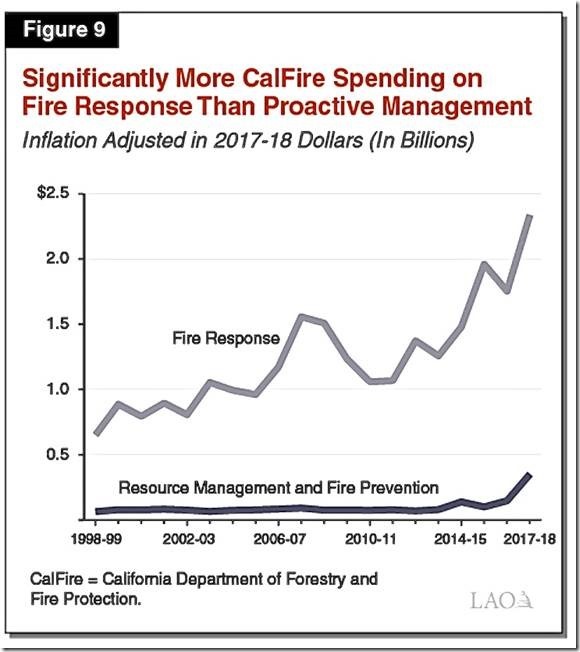
The federal government changed its priority in 1964 from burn down command to burn down direction equally noted in the written report:
"The passage of the 1964 Wilderness Act encouraged allowing natural processes to occur, including fire. Accordingly, USFS has changed its policy from firecontrol to firemanagement, allowing fires to play their natural ecological roles as long as they can be contained safely based on conditions patterns, terrain, proximity to development, and other factors. This policy includes both naturally caused fires and intentionally prescribed fires. This shift reflects a growing resurgence in the perspective that moderate fires can accept benign furnishings on forestlands, such as clearing out smaller brush and stimulating natural processes like tree seed dispersal and replenishment of soil nutrients."
California'due south government and regulatory agency policies, procedures and actions are out of step with the need to address wood direction actions in a style that finer enhances forest health and decrease wildfire risks and occurrences.
The LAO study issues noted above do not represent all of the problem areas identified in this written report merely provide a clear portrayal of the staggering and mind numbing complication and ineffectiveness of the states governmental and regulatory agencies and policies that accept led to the present debacle in California forest management with the result being significantly increased wildfire risks and occurrences with devastating results in California's communities.
Those responsible for this dire situation in the country government and its regulatory agencies along with their media supporters have tried to conceal the country's role in manufacturing this debacle and instead falsely focus attention on scientifically unsupported claims of "climate change" equally existence responsible for California's problems while Californians continue to endure.
In addition to the states massive overlay of ineffective and bureaucratic regulatory agencies that have fabricated such a mess of dealing with California's forest management and wildfire prevention needs a new impediment from these agencies has now emerged regarding the critical ability for communities experiencing disastrous wild fires such as occurred in the urban center of Paradise to be able to go on with recovery every bit noted in a recent Sacramento Bee article.

The commodity notes:
"Environmental concerns, including fright of harming sensitive frog species, have forced Military camp Burn crews to dorsum abroad from cleaning some properties in the Paradise area.
State officials tasked with debris cleanup say they have been directed not to enter an estimated 800 burned Butte Canton home sites within 100 feet of a waterway. They've been told to wait for representatives of several state and federal agencies to reach an understanding on environmental assessment guidelines.
The issue cropped upward well into a yearlong, estimated $2 billion-plus cleanup operation at near xi,000 properties in Paradise, Concow, and Magalia that burned in November's Camp Burn down, the most destructive bonfire in state history.
The revelation that some stream-side properties are at present on hold triggered a potent public rebuke Thursday from two local legislators who said they heard well-nigh the issue from angry constituents on the ridge."
The state'south climate alarmist politicians, media and climate activists have attempted to make nebulous and lame excuses that man fabricated "climate change" is accountable for the poor forest weather and increased wildfires but these claims are unsupported by climate data going dorsum more than 1,000 years showing extensive periods of extreme droughts and precipitation in California have long existed and that no definitive change in this very long term climate record has been established as was noted in a Los Angeles Times article from 2014.

In a more than recent Los Angeles Times article the headline speculated that man made climatic change impacts maybe associated with the long record of the states drought and precipitation on the ground of "estimator models" but the manufactures substance doesn't support the hype reflected in its headline. In fact the commodity states that:
"Some researchers aren't nonetheless convinced that the results show a clear homo influence on past drought trends."
"But scientists take had a tougher time picking out the furnishings on atmospheric precipitation, which should increase in some places and decrease in others."
"Role of the problem is that the changes driven by humanity'due south product of greenhouse gases usually become swamped by the tremendous natural variability of the climate system, particularly when studying the history of a specific region."
"Other researchers said the study authors' method tin't determine whether the soil moisture changes recorded in the tree ring data occurred because of an increase in greenhouse gases or because of natural causes — which are also included in the model simulations used to create the fingerprint. For case, there's evidence that the sun emitted slightly more free energy over the first half of the 20th century, which also affected the climate."
An all-encompassing report published in ScienceDirect addressed the Northward American drought history going back to year 800 using tree ring data. The study noted the following regarding the long term climate behavior of drought and precipitation in the Westward:
"Severe drought is the greatest recurring natural disaster to strike North America. A remarkable network of centuries-long annual tree-ring chronologies has at present immune for the reconstruction of past drought over North America covering the by 1000 or more years in almost regions. These reconstructions reveal the occurrence of past "megadroughts" of unprecedented severity and duration, ones that have never been experienced by modern societies in North America. There is strong archaeological bear witness for the destabilizing influence of these past droughts on advanced agricultural societies, examples that should resonate today given the increasing vulnerability of modernistic h2o-based systems to relatively brusk-term droughts."
"Recent advances in the reconstruction of by drought over N America and in modeling the causes of droughts there have provided important new insights into one of the most plush recurring natural disasters to strike North America. A grid of summer PDSI reconstructions has been adult now for most of Northward America from a remarkable network of long, drought sensitive tree-ring chronologies. These reconstructions, many of which comprehend the past thousand yr, accept revealed the occurrence of a number of unprecedented megadroughts over the by millennium that clearly exceed whatever found in the instrumental records since about Advertisement 1850, including an epoch of significantly elevated dehydration that persisted for almost 400 yr over the Advertising 900–1300 period. In terms of elapsing, these past megadroughts dwarf the famous droughts of the 20th century, such as the Dust Basin drought of the 1930s, the southern Dandy Plains drought of the 1950s, and the electric current one in the West that began in 1999 and still lingers on equally of this writing in 2005."

These results established natural climate drivers are backside the all-encompassing drought and precipitation cycles over the last more 1,000 years as noted in the graph provided below indicating that the politically driven claims by climate alarmists that "climate change" is driving drought and precipitation outcomes in the W is flawed.

The 1,000 year long tree band data tape provided in the information above demonstrates that California has been subjected to extensive intervals of natural climate change driven cycles of droughts and atmospheric precipitation events for centuries. Claims that recent drought and precipitation events are somehow influenced by "man fabricated climate change" are scientifically flawed and correspond nothing but climate alarmist speculation and conjecture.
The Cal Burn down and LAO reports present a real globe moving picture identifying that California'due south regime and regulatory agencies are responsible for the present terrible status of California'due south forests along with the resulting increased wildfire risks and occurrences. The excuse that "climate modify" has caused these problems is nothing but scientifically unsupported propaganda being used in an attempt to muffle that the state authorities is actually responsible for these outcomes.

How Much Forest Service Land Has Burned In Ca,
Source: https://www.climatedepot.com/2020/09/16/analysis-californias-government-solely-responsible-for-states-forest-management-and-wildfire-debacle/
Posted by: ramirezdecterral52.blogspot.com
0 Response to "How Much Forest Service Land Has Burned In Ca"
Post a Comment